Where the office is
operating infrastructure.
The corporate office is operating infrastructure.
The cross-functional crossroads.
Hierarchy reads in the floor plan.
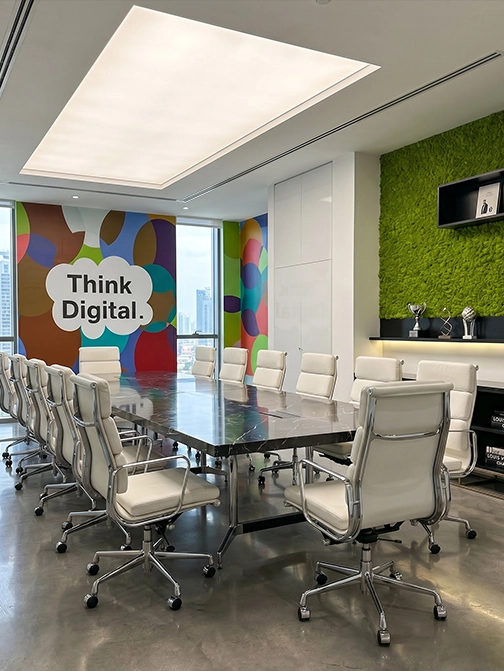
Brand confidence is the dominant signal.
The workspace earns its place in the design when it matches the operation.
What a Codex engagement surfaces — and resolves.
Tension 01 Hierarchical clarity vs. cross-functional fluidity.
The org chart says Directors get corner offices, VPs get cabins, AGMs get partial enclosures. The operational workflow says Engineering and Operations need to be within a 30-second walk, Quality needs daily proximity to both, and Supply Chain needs sight-lines into all three. Both pressures are valid. Both collide on the same floor plate.
How the Codex resolves itThe Adjacency Complexity Score maps functional-pair proximity needs. Define commits to a hybrid floor strategy — cabin-cluster zones for leadership positioned at the boundary of open-plan functional zones — so hierarchy reads spatially without throttling cross-functional flow.
Tension 02 Brand projection vs. operational identity.
Leadership wants the HQ to project the firm’s growth ambitions to customers and partners. The workforce — and frankly the leadership team’s own daily reality — wants spaces that match the firm’s actual operational culture. Both legitimate. Often unspoken until the reference imagery starts arriving.
How the Codex resolves itDecode surfaces both — the projection brief and the operational identity — in week one. Define commits to a calibrated finish strategy that reads confidently to visitors without distancing from the daily reality of how the business actually runs.
Tension 03 Plant proximity vs. HQ identity.
Some HQs sit on the plant campus. Some sit across the city. Some sit across states from the manufacturing footprint. Each demands different workspace responses — plant-sync infrastructure, audit-team accommodation, remote-management protocols — but few teams articulate which version they actually need before design begins.
How the Codex resolves itDecode reads the plant-corporate operating rhythm: how often does plant data drive HQ decisions, how often do plant teams visit, how often do audit teams arrive? Define commits to specific plant-sync infrastructure — video-conference rooms calibrated for plant-floor sound profiles, OEE dashboard placement, audit-zone provisions — sized to the actual rhythm, not the imagined one.
Tension 04 Operational methodology vs. design intent.
Gemba walk routes, 5S audit sightlines, IATF audit-team flow paths, Six Sigma DMAIC review rooms — these are real workspace constraints driven by certifications and customer requirements. They surface late if not surfaced at Decode. A floor designed without them looks beautiful and then quietly fails its first audit.
How the Codex resolves itThe Compliance/Regulatory Surface KPI for manufacturing explicitly maps certification-driven workspace requirements — ISO 9001, IATF 16949, OHSAS, sector-specific regimes (GMP for pharma-adjacent, AS9100 for aerospace, etc.). Define lists these as first-class inputs alongside team needs and brand brief.
Tension 05 Stated tier vs. operational identity.
The brief says Luxury. Reference imagery arrives from glossy global HQs. The operational identity of the business — the actual rhythm of plant calls, audit weeks, vendor meetings, customer factory tours — calls for something more functional. The workspace can read either way. Choosing without conscious calibration usually costs at Detail phase.
How the Codex resolves itThe Tier-Reality Match Score calibrates stated ambition against operational identity in week one. The aim isn’t to discourage Luxury — many manufacturing groups genuinely warrant it. The aim is to ensure the tier matches the business, not the imagery. Honest at sign-off; coherent at handover.
The KPIs that define manufacturing
workspaces.
Workflow Concentration
Adjacency Complexity Score
Tier-Reality Match Score