Now Open
The APXWorks Experience Center is now welcoming visits in Ahmedabad — by appointment only.

Pharma

Where the audit lives in the corporate office.

3Diagnostic KPIs
5Sector tensions
6+Simultaneous regulatory regimes
Pharmaceutical companies, generics manufacturers, CDMOs, biotech, medical devices. Corporate workspaces where USFDA, CDSCO, EU GMP, WHO PQ, and customer audits arrive in a routine cadence — and where documentation discipline meets workspace discipline.

What pharma workspaces actually are.

Before the design conversation, before the brief, before any line is drawn — these are the five conditions that define what a pharma corporate workspace must do. The realities apply most sharply to Indian pharmaceutical company corporate HQs and CDMOs operating across multiple regulatory jurisdictions. Biotech and medical devices firms share the same logic with sector-specific calibration. R&D lab interiors and GMP-grade manufacturing are specialist work outside the corporate-HQ scope.
Reality 01

Information boundaries are about IP, not investors.

When a USFDA, CDSCO, EU GMP, MHRA, TGA, Anvisa, or WHO PQ inspector audits a pharma firm, they don't only audit the plant. They audit the QMS, the SOPs, the change controls, the deviations log, the CAPA system, the management reviews — all of which originate from and live in the corporate HQ. The plant is one component of the inspection. The corporate office is the rest.
This means the corporate workspace must read as audit-grade from reception forward. Document review zones, audit-team accommodation, regulatory affairs work areas — these aren't optional rooms. They're how the firm passes inspection.
Reality 02

The cross-functional crossroads.

Pharma corporate HQs run multiple program teams in parallel — each working on different molecules, each with confidentiality requirements that span everything from molecule structure to filing strategy to launch timing. Generics businesses run 30–60 ANDA programs simultaneously. CDMOs run client-firewalled engagements where one customer's data cannot touch another's.
The Information Boundary Count for pharma is structural, not regulatory: who can see which program, which team can sit adjacent to which, where M&A integration teams sit relative to ongoing operations. Misreading this means redesigning, or worse — a breach of client trust.
Reality 03

The serialization-to-boardroom traceability.

Modern pharma operates with continuous data flow: batch records, serialization (DSCSA, EU FMD), DPCO pricing data, deviations, change controls, OOS investigations — all moving from plant to QMS to corporate to regulator and customer. Every conference room may host a discussion that traces a decision back to a specific batch.
The workspace must support this data discipline: audit-grade AV in review rooms, document-prep environments for regulatory dossiers, secure data zones for clinical and trial work, traceability infrastructure that doesn't degrade with finish-out.
Reality 04

Multiple regulatory regimes, simultaneously.

A typical Indian pharma firm operates under six or more regulatory regimes at once — USFDA for US exports, EMA for EU, MHRA for UK, TGA for Australia, Anvisa for Brazil, CDSCO for India, plus WHO PQ for institutional procurement and ongoing customer audits from major buyers. Each has its own audit cadence, its own documentation expectations, its own visitor protocols.
This means the visible 20–30% of floor area — reception, primary meeting rooms, customer-facing zones — carries disproportionate weight. Investor Experience Footprint applies here too, recalibrated for a manufacturing visitor: less about polish, more about confident competence.
Reality 05

Stakeholder Sign-off Count is unusually high.

Pharma decision-making routes through more sign-offs than almost any sector. Major decisions involve Quality Head, Regulatory Affairs Head, R&D Head, Manufacturing Head, Compliance Head, Medical Affairs, Legal, plus board and external advisors for filings, launches, and recalls. Each sign-off requires its own meeting, its own documentation, its own room.
The workspace either supports this routing discipline — adequate meeting infrastructure, document-staging zones, sign-off-ready environments — or quietly fights it. Pharma boards have been known to delay launches because the documentation review couldn't be completed in the corporate office.

What a Codex engagement surfaces — and resolves.

Every pharma workspace project carries the same five underlying tensions. They don't disappear with better designers. They don't soften with more budget. The Codex's job is to surface them in week one — not week ten — and commit to a resolution before construction begins. Tap each tension to see how.

The KPIs that define pharma workspaces.

Three of the 16 KPIs the Codex measures sit at the centre of every pharma engagement. They aren't the only ones that matter — but they're the ones that, if mis-read, reshape every later decision.
Operational KPI · #10 in framework

Compliance/Regulatory Surface

Percentage of design decisions affected by external regulation.
For pharma corporate HQs, this sits between 45–65% — the highest of any sector APXWorks works in. USFDA, CDSCO, EU GMP, MHRA, TGA, Anvisa, WHO PQ — plus customer audits from major institutional buyers. Audit-team accommodation, document review zones, regulator-visit choreography, controlled-access pathways, retention-period storage — all compliance-driven, all spatial.
Spatial KPI · #06 in framework

Adjacency Complexity Score

Number and intensity of functional-pair proximity needs across the workforce, weighted by required separation.
Pharma carries the highest Adjacency Complexity of any sector — typically 14–22 mandated adjacencies and separations across a mid-size corporate HQ. R&D programs must collaborate internally but separate externally. Quality and Regulatory Affairs must sit close to each other but partly separate from operations. M&A integration teams need quarantine zones. The score drives the floor plan.
Operational KPI · #12 in framework

Information Boundary Count

Number of information barriers a workspace must enforce — between competing programs, client engagements (CDMOs), and confidential operational data.
For pharma, this measures structural IP boundaries: typically 4–8 mandated boundaries for a mid-size firm. Generics programs vs. each other. Innovator R&D vs. generics business. M&A integration vs. day-to-day. CDMO client engagements vs. each other. Misreading this in week one means a breach of internal IP or external client trust.
The full 16-KPI framework spans spatial, operational, and trajectory categories. Read the complete framework on the APX Codex page →
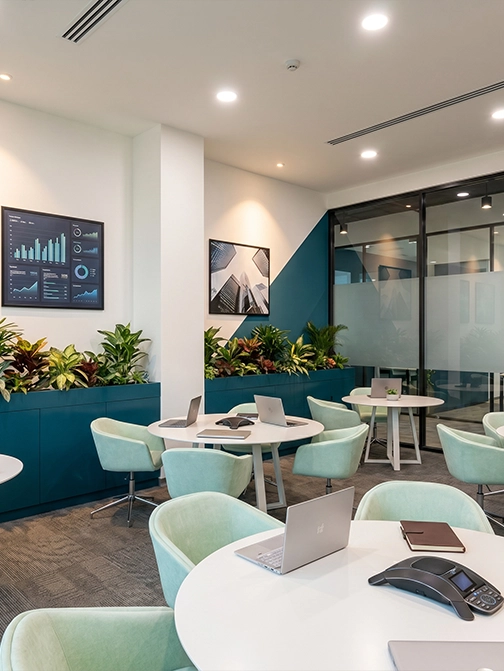
A considered financial-services workspace — biophilic detailing, controlled visitor sequence, disciplined finish allocation

An Indian generics manufacturer. 22,000 sq.ft corporate HQ. USFDA + EU GMP + WHO PQ.

"The brief specified a single R&D zone of 8,000 sq.ft. The Information Boundary Count said: the firm runs 42 concurrent ANDA programs. One zone, no walls means one filing leak."
The firm: a mid-size Indian generics manufacturer with three plants — two in Gujarat, one in Andhra Pradesh — exporting to US, EU, UK, Brazil, and South Africa. Around 180 people in the corporate HQ, spanning Quality, Regulatory Affairs, R&D (formulations and analytical), Manufacturing oversight, Supply Chain, Commercial, and Corporate Functions. The HQ was being relocated to consolidate from two older buildings into a single floor at a Premium business park.
The brief had been written by an architecture firm that hadn't worked in pharma. It specified a single open-plan R&D zone of 8,000 sq.ft, a conventional reception, three meeting rooms, and a board room. Decode surfaced the problem in week one: the firm was actively running 42 concurrent ANDA programs (US generic filings), 18 EU dossier preparations, and four innovator-collaboration agreements. A single R&D zone meant every program team could see every other program's work. The next USFDA inspection would identify this as a data integrity concern — and the next major customer audit would identify it as a confidentiality concern.
The Define document proposed a program-zone architecture: the R&D area split into four sub-zones (formulations-A, formulations-B, analytical, and the innovator-collaboration team in its own quarantine zone), each with controlled access and dedicated meeting rooms. The reception was reworked into an audit-grade environment with regulator-accommodation zones, document review rooms, and a separate visitor flow for major-customer audits. The board room was paired with two committee rooms for routine governance.
Compliance/Regulatory Surface: measured at 52% — meaning more than half of design decisions traced back to a regulatory or audit-related requirement. Information Boundary Count: 6 mandated. Adjacency Complexity Score: 18 — high, including the program-zone separations and the Quality–Regulatory Affairs–Manufacturing coordination triangle. Tier-Reality Match: calibrated to Premium with Luxury in the audit-grade perimeter.
Decode delivered the audit, the program-zone proposal, and the audit-grade perimeter specification by end of week four. Define closed in week eight, signed by the MD, Quality Head, Regulatory Affairs Head, and R&D Head. The R&D zones run their programs without competing-program visibility. The USFDA inspector who arrived nine months after handover did not flag a single data integrity concern. The space matches the operational discipline the firm already runs by — visible to inspectors and lived in by the team.
Codex methodology study · Pharma sector · representative of how the Codex applies to an Indian generics manufacturer.
Stylised study; not derived from a single client engagement.

Three specific reasons — beyond "experience."

Reason 01

Audit-grade workspace discipline, not as afterthought.

Pharma corporate HQs aren't generic offices that occasionally host audits. They're audit-ready environments by design — from reception choreography to document review zones to regulator-accommodation infrastructure. APXWorks designs for inspection-readiness from Decode forward, not as a finish-out concern.
Reason 02

Multi-jurisdiction regulatory fluency at floor-plan scale.

USFDA, CDSCO, EU GMP, MHRA, TGA, Anvisa, WHO PQ — and the IP and confidentiality discipline these regimes impose — these are workspace inputs, not afterthoughts. APXWorks calibrates to the strictest applicable regime as baseline, knowing the rest gets satisfied automatically. This is the discipline pharma firms with US export programs already understand. The Codex applies it to the workspace.
Reason 03

Design and build under one accountability.

APXWorks builds what APXWorks designs. Same team from Decode through Deliver. For pharma corporate HQs — where document storage retention, audit-grade AV calibration, program-zone enforcement, and visitor-path control all matter to the next inspection — translation losses between design and execution are unacceptable.

Typical pharma engagement.

Indicative parameters for a Premium pharma corporate HQ engagement. Real engagements calibrate to your specific regulatory mix, program portfolio, and operational identity.
Project size

15,000 – 35,000 sq.ft

Typical corporate HQ for a mid-to-large pharma firm or CDMO. R&D lab interiors and GMP manufacturing scoped separately as specialist work.
Tier & pricing

Premium to Luxury

₹2,500 – 3,500 per sq.ft for Design + Build. Audit-grade perimeter often sits a tier above operational floor.
Engagement length

22 – 32 weeks

Decode 4 wks · Define 5 wks · Design 6 wks · Detail 5 wks · Deliver 6–12 wks. Decode extended for regulatory and program-zone mapping.
Full pricing and engagement-tier detail on the Services page. Pricing varies with finish allocation, scope, and timeline.

Start where your sector pulls hardest.

Explore another sector