Now Open
The APXWorks Experience Center is now welcoming visits in Ahmedabad — by appointment only.

Technology

Where the workspace scales with the team — and helps win the offer.

3Diagnostic KPIs
5Sector tensions
8–12Simultaneous regulatory regimes
Software products, IT services, platform companies, GCCs, captives, mid-stage tech. Corporate workspaces designed for headcount elasticity, hybrid rhythms, and the candidate-visit moment that closes the offer. Where culture lives in the floor plan.

What technology workspaces actually are.

Before the design conversation, before the brief, before any line is drawn — these are the five conditions that define what a technology workspace must do. The realities apply most sharply to software product firms, IT services, GCCs and captives, and growth-stage tech companies. Tech-adjacent firms — fintech, edtech, healthtech — share the same logic with sector-specific calibration.
Reality 01

The workspace is a recruitment lever.

In tech, the workspace shows up in the offer conversation. The candidate visit, the floor walk-through, the meeting with the engineering team in their working environment — these moments shape whether a Tier 1 engineer accepts the offer or takes the competing one. Workspaces in this sector aren't just operational infrastructure. They're part of the EVP — the employee value proposition.
This changes how the visible workspace must read: not as a marketing showroom (that signals corporate distance), but as a place where good work obviously happens — confident, considered, alive with the rhythms of real teams.
Reality 02

Headcount Trajectory is unforgiving.

Funded tech companies routinely scale headcount 30–100% in 18 months. Capital-disciplined or restructuring firms contract 20–40% in the same window. Workspaces designed for current headcount fail within a year. Workspaces designed for projected headcount feel empty and demoralising until the team grows in.
The Codex's Headcount Trajectory KPI quantifies this in week one: forward projection, scenario range, lease alignment. The discipline is designing for the wave, not the snapshot — modular infrastructure, scalable density, future-mitigation provisions that activate as the team grows.
Reality 03

Hybrid work reshapes everything.

Post-2020, no tech workspace decision can route around the hybrid question. How many in-office days per week? Anchor days or flexible? Fixed desks or hot-desking? What ratio? The answer shapes desk count, locker provision, focus-pod count, café-grade pantry sizing, and every adjacency in the floor plan.
Getting this wrong is expensive in either direction. Designing for 5-day attendance when reality is 2.5 days means a 50% empty floor. Designing for 2.5-day attendance when reality returns to 5 means scrambling for desks. Decode reads the firm's actual hybrid intent — not the stated one — and Define commits to a workspace calibrated for what will be lived.
Reality 04

Workspace Type Diversity is the design problem.

Tech HQs routinely need 8–12 distinct workspace types: open-plan engineering floors, focus pods, phone booths, video-call rooms, collaboration zones, lounges, café-pantries, training rooms, town hall spaces, library zones, breakout areas, customer-demo zones. Each serves a different work mode. Each ratios against the others.
The discipline isn't maximalism — adding every space type the team can name. It's balance. The Workspace Type Diversity KPI captures the ratio question: how many of each, sized to what use frequency, positioned where on the floor. Get the balance wrong and the floor has empty pods and overflowing meeting rooms.
Reality 05

Tension Density is real.

On the same floor at the same hour: engineers in flow state, product managers in standups, designers in critique sessions, sales teams on customer calls, leadership in 1:1s, candidates being walked through. Each mode has different acoustic, visual, and infrastructural needs. The workspace either accommodates this density of tensions gracefully or quietly produces friction.
The Codex's Tension Density KPI measures how many simultaneous work modes a typical floor hour must support. Higher counts mean more zoning discipline, more acoustic care, more circulation thoughtfulness. Tech workspaces routinely score 6–8 simultaneous modes — among the highest of any sector.

What a Codex engagement surfaces — and resolves.

Every technology workspace project carries the same five underlying tensions. They don't disappear with better designers. They don't soften with more budget. The Codex's job is to surface them in week one — not week ten — and commit to a resolution before construction begins. Tap each tension to see how.

The KPIs that define technology workspaces.

Three of the 16 KPIs the Codex measures sit at the centre of every technology engagement. They aren't the only ones that matter — but they're the ones that, if mis-read, reshape every later decision.
Trajectory KPI · #13 in framework

Headcount Trajectory

Projected headcount evolution over a 24–36 month horizon, with scenario range.
For tech firms, this is the dominant variable. Funded growth-stage firms project 30–100% scaling over 18 months; capital-disciplined firms project flat-to-modest; restructuring firms project contraction. The workspace must serve the projection's range, not a single point. Misreading the trajectory in week one means an empty floor in 18 months or a cramped one in 12.
Spatial KPI · #05 in framework

Workspace Type Diversity

Number of distinct workspace types, ratioed against floor area and use frequency.
Tech HQs routinely need 8–12 distinct workspace types: open-plan engineering, focus pods, phone booths, video-call rooms, collaboration zones, lounges, café-pantries, training rooms, town hall spaces, library zones, breakout areas, customer-demo zones. The diversity isn't aspirational — it's operational. The ratio question is the design question: how many of each, sized to what use frequency, positioned where.
Operational KPI · #11 in framework

Tension Density

Number of simultaneous work modes a typical floor hour must support.
Tech workspaces routinely score 6–8 simultaneous modes — engineers in flow, designers in critique, PMs in standups, sales on calls, 1:1s in progress, candidates being walked. Higher counts mean more zoning discipline, more acoustic care, more circulation thoughtfulness. The number drives where focus zones sit, where collaboration zones sit, and how the floor's acoustic strategy resolves the conflict.
The full 16-KPI framework spans spatial, operational, and trajectory categories. Read the complete framework on the APX Codex page →
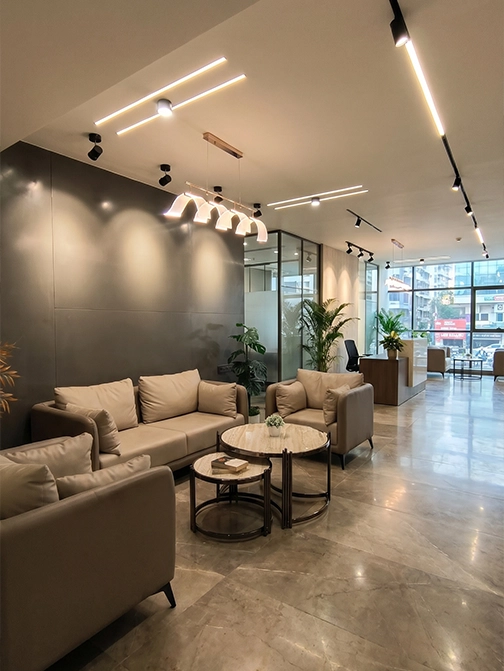
A considered financial-services workspace — biophilic detailing, controlled visitor sequence, disciplined finish allocation

A mid-size IT services firm. 35,000 sq.ft. Pune. Premium tier brief.

"The brief specified 60% open-plan engineering desking. The Tension Density score said: the floor will average 7 simultaneous work modes. Pure open-plan will lose the engineers within a quarter."
The firm: a mid-size IT services and product engineering company with 240 people at engagement start, scaling to a projected 340 over 24 months on the back of two large enterprise client wins. Mix of engineering (140), product and design (40), customer success and account management (35), corporate functions (25). The floor was being taken in a Pune business park to consolidate from three smaller offices, with explicit positioning as a recruitment hub for the growth wave.
The brief was conventional: 60% open-plan engineering desking, 20% meeting and collaboration zones, 10% leadership cabins, 10% common areas. Decode surfaced the problem in week two: the firm's workforce profile and hybrid policy (3 anchor days, flexible Fridays) meant the typical floor hour would see engineers in flow, product teams in standups, sales on customer calls, designers in critique, and candidate walks all happening simultaneously. Pure open-plan engineering would lose acoustic war to the higher-volume modes — and the firm's stated recruitment ambition depended on engineer retention.
The Define document proposed a mode-zoned floor plan: engineering zones with acoustic isolation (focus pods, library-grade quiet zones, phone-booth provision for calls within engineering), a separate collaboration band for product/design with whiteboards and acoustic permissiveness, a customer-engagement perimeter with the better natural light and finish quality (serving both candidate visits and customer demos), and a café-pantry positioned as the daily anchor for the in-office days.
Headcount Trajectory: scenario-modelled at 240/280/340 across 24 months — design committed to scalability at the upper bound, with locker and hot-desk infrastructure right-sized for the central scenario. Workspace Type Diversity: 11 distinct types (engineering, focus pods, phone booths, video rooms, collaboration zones, customer-demo, training, town hall, library, lounge, café-pantry). Tension Density: 7 simultaneous modes, with zoning discipline allocated across the floor accordingly. Tier-Reality Match: calibrated to Premium throughout, with selective Luxury in the customer-engagement and candidate-visit perimeter.
Decode delivered the audit, the program-zone proposal, and the audit-grade perimeter specification by end of week four. Define closed in week eight, signed by the MD, Quality Head, Regulatory Affairs Head, and R&D Head. The engineers kept their flow state. The customer-engagement perimeter closed two enterprise deals in the first quarter post-handover. The talent funnel — measured by candidate offer-acceptance rate — improved 14 points over the prior office. This is what designing for the wave rather than the snapshot produces.
Worked example · Technology sector · stylised from a representative engagement.
Specific firm details have been anonymised. The methodology and findings are real.

Three specific reasons — beyond "experience."

Reason 01

Trajectory thinking, not snapshot design.

Tech firms scale and contract faster than any other sector. APXWorks designs for the projected workforce range — modular desking infrastructure, scalable hot-desk provisions, locker counts that flex with hybrid policy. The workspace serves where the firm is going, not just where it is. Snapshot design fails within a year; trajectory design serves three.
Reason 02

Recruitment fluency at floor-plan scale.

The candidate walk-through is a real workspace requirement, not a marketing concern. APXWorks designs for the candidate moment — the path from reception to engineering floor, the café-pantry that signals culture, the collaboration zones that show how work actually happens. The workspace earns its place in the offer conversation.
Reason 03

Design and build under one accountability.

APXWorks builds what APXWorks designs. Same team from Decode through Deliver. For tech HQs — where the acoustic calibration of an engineering zone, the AV in a town hall space, and the finish quality of the candidate-visit perimeter all matter — translation losses between design and execution are unacceptable.

Typical technology engagement.

Indicative parameters for a Premium tech corporate HQ engagement. Real engagements calibrate to your specific stage, hybrid policy, and growth trajectory.
Project size

15,000 – 60,000 sq.ft

Typical tech HQ for product or services firm at growth stage. Larger campus engagements (GCC, multi-floor) scoped individually.
Tier & pricing

Premium to Luxury

₹2,500 – 3,500 per sq.ft for Design + Build. Visible perimeter often Luxury for talent positioning; operational zones Premium.
Engagement length

18 – 26 weeks

Decode 3 wks · Define 4 wks · Design 5 wks · Detail 4 wks · Deliver 4–10 wks. Scaling provisions extend Detail.
Full pricing and engagement-tier detail on the Services page. Pricing varies with finish allocation, scope, and timeline.

Start where your sector pulls hardest.

Explore another sector