Now Open
The APXWorks Experience Center is now welcoming visits in Ahmedabad — by appointment only.

Energy

Where stakeholder weight
reshapes every room.

3Diagnostic KPIs
5Sector tensions
7–10Visitor types per month
Power generation, transmission, distribution, renewables operators, utilities, oil and gas. Corporate workspaces that host regulators, lenders, JV partners, ESG auditors, and government delegations in successive weeks — and that must read clearly to all of them.

What energy workspaces actually are.

Before the design conversation, before the brief, before any line is drawn — these are the five conditions that define what an energy corporate workspace must do. The realities apply most sharply to corporate head offices of power generation companies, transmission and distribution operators, renewables players, and utilities. Oil and gas corporate offices share the same logic with sector-specific calibration.
Reality 01

The regulator is always in the room.

Even when no regulator is physically present, the workspace decisions are read through a regulatory lens. CEA, CERC, SERC, MNRE, MoP, state electricity boards, pollution control boards, the NGT — and increasingly SEBI's BRSR climate-disclosure expectations — all touch how an energy HQ must operate.
This isn't abstract. Tariff petitions are prepared in these rooms. Environmental clearances are presented from these conference tables. The workspace either supports that regulatory discipline or quietly complicates it.
Reality 02

Visitor diversity is the design problem.

Energy HQs host more visitor types per month than almost any sector. Regulators, lenders, JV partners (often international), ESG and climate auditors, equipment vendors, government delegations, project-finance teams, customers (for B2B utilities), local-community representatives. Each visitor type expects to be received differently.
The workspace either accommodates this diversity gracefully or forces awkward improvisation. Visitor Frequency captures the volume; Visitor Type Diversity captures the choreographic challenge.
Reality 03

The deep authority stack.

Energy companies carry unusually deep decision chains. Boards, independent directors, regulators, parent companies (in subsidiary structures), JV partners, project-level committees, lender consortiums, ratings agencies — all sit in the routine governance stack. Even mid-size players have 6–8 authority layers touching major decisions.
The workspace must support multi-stakeholder governance as routine work, not exception. Board rooms, committee rooms, JV-partner meeting zones, lender review rooms — these aren't occasional. They're the operating rhythm.
Reality 04

Long-cycle business, slow-burn workspace.

Energy projects run 5 to 25 years. A solar park PPA is signed for 25. A thermal plant operates for 30. A transmission corridor outlives the engineers who designed it. Workspaces in this sector aren't fitted out for tomorrow's product launch — they're fitted out for two decades of consistent operating discipline.
This changes how Trajectory KPIs read: Headcount Trajectory matters less than project-portfolio trajectory. The workspace needs to age gracefully — finishes that hold, infrastructure that scales, room types that adapt as the portfolio matures.
Reality 05

ESG and climate reporting is workspace activity.

The rise of BRSR, IFRS S2, TCFD, GRI, and rating-agency climate disclosure has made sustainability data a routine workspace activity. Climate-team meeting rooms, ESG audit zones, BRSR data-prep environments, scenario-modelling stations — these are workspace components now, not aspirations.
Energy HQs that retrofit ESG zones after the fact end up with awkward adjacencies and stranded conference rooms. The Codex treats ESG and reporting infrastructure as first-class workspace input from Decode forward.

What a Codex engagement surfaces — and resolves.

Every energy workspace project carries the same five underlying tensions. They don't disappear with better designers. They don't soften with more budget. The Codex's job is to surface them in week one — not week ten — and commit to a resolution before construction begins. Tap each tension to see how.

The KPIs that define energy
workspaces.

Three of the 16 KPIs the Codex measures sit at the centre of every energy engagement. They aren't the only ones that matter — but they're the ones that, if mis-read, reshape every later decision.
Operational KPI · #10 in framework

Compliance/Regulatory Surface

Percentage of design decisions affected by external regulation.
For energy firms, this sits between 40–60% — among the highest of any sector. CEA, CERC, SERC, MNRE, MoP, state electricity boards, pollution control boards, the NGT, and increasingly SEBI's BRSR framework all shape workspace specifications. Tariff hearing rooms, environmental clearance prep zones, regulator-visit choreography — all compliance-driven, all spatial.
Operational KPI · #09 in framework

Visitor Frequency

Volume and diversity of external visitor flow per month.
Energy HQs run 7–10 distinct visitor types in a typical month — regulators, lenders, JV partners, ESG auditors, vendors, government delegations, project-finance teams. Total visitor count routinely 40–80 per month for mid-size players. This volume reshapes the front-of-house perimeter and the visitor choreography.
Operational KPI · #08 in framework

Decision Authority Layers

Number of distinct authority levels that must routinely meet, deliberate, and sign off.
Energy companies routinely carry 6–8 authority layers: boards, independent committees, executive teams, parent-company oversight, JV partners, lender consortiums, project committees, regulators. Each layer expects spatial expression. The workspace footprint that supports this stack is roughly 15–25% of total floor — substantially higher than most sectors.
The full 16-KPI framework spans spatial, operational, and trajectory categories. Read the complete framework on the APX Codex page →
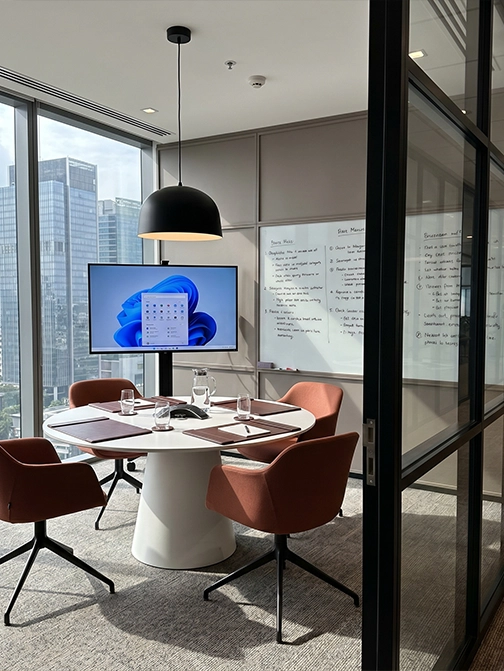
A working meeting room — calibrated for the multi-stakeholder cadence of an energy corporate office

A renewables operator. 18,000 sq.ft corporate HQ. Six-month visitor analysis at Decode.

"Decode counted 72 distinct external visitor sessions in the prior six months — across nine visitor types. The brief had budgeted for one boardroom and three meeting rooms. The math said: not enough."
The firm: a mid-size independent power producer with a renewables-led portfolio (solar, wind, evolving toward storage). 140 people across Operations, Project Development, EPC oversight, Finance, Regulatory Affairs, ESG, and Corporate Communications. The HQ was being scaled to host a growing JV portfolio and an institutional-lender-driven governance cadence.
Decode ran a six-month visitor analysis as part of the operational read. The count: 72 external visitor sessions. The mix: 14 regulator delegations (CEA, CERC, state boards), 11 lender review teams, 9 JV partner meetings (including 4 with international IPP partners), 8 ESG and rating-agency audits, 7 equipment-vendor presentations, 6 government and political delegation visits, 5 project-finance closing sessions, 4 board and independent-director sessions, and 8 customer or PPA-counterparty meetings.
The brief had budgeted a single board room, a customer-engagement suite, and three general meeting rooms. The Define document tabled a layered governance footprint instead: a formal board area (used 4–6 times annually for board, regulator, and high-stakes lender sessions); two committee-grade rooms (used monthly for JV, ESG, and project-committee work); and four team-scale meeting rooms (used daily). Plus a dedicated regulator-readable wing with audit-grade AV and document-prep infrastructure.
Compliance/Regulatory Surface: measured at 48% — meaning nearly half of design decisions traced back to a regulatory or external-stakeholder requirement. Visitor Frequency: high. Decision Authority Layers: 7 (board, independent committees, executives, parent oversight, JV partners, lender consortium, project committees). Tier-Reality Match: calibrated to Premium with Luxury in the visitor perimeter.
Decode delivered the visitor audit, the layered governance proposal, and the regulator-readable wing specification by end of week three. Define closed in week seven. The board room hosts the board, not the JV meeting that arrived without warning. The lender review has its own room. ESG audits no longer commandeer the customer suite. The space matches the operating rhythm — not the imagined one.
Codex methodology study · Energy sector · representative of how the Codex applies to an independent renewables operator.
Stylised study; not derived from a single client engagement.

Three specific reasons — beyond "experience."

Reason 01

Multi-stakeholder fluency at floor-plan scale.

Energy HQs aren't generic offices that occasionally host visitors. They're multi-stakeholder operating environments where regulators, lenders, JV partners, and ESG auditors arrive in routine cadence. APXWorks designs for the visitor choreography from Decode forward — not as an afterthought once construction begins.
Reason 02

Regulatory and ESG vocabulary, not learned mid-project.

CEA, CERC, SERC, MNRE, MoP, state electricity boards, the NGT, BRSR, IFRS S2 — these are regulatory inputs to workspace design, not abstractions. APXWorks reads the energy regulatory perimeter as a foundational input alongside team workflow and visitor flow. By Define, the regulator-readable zones are committed; by Detail, the ESG-reporting infrastructure is specified.
Reason 03

Design and build under one accountability.

APXWorks builds what APXWorks designs. Same team from Decode through Deliver. For energy HQs — where the AV calibration in a tariff-hearing room or the document-prep infrastructure in an ESG audit zone defines whether the workspace serves the operation — translation losses between design and execution are unacceptable.

Typical energy engagement.

Indicative parameters for a Premium energy corporate HQ engagement. Real engagements calibrate to your specific operating cadence and stakeholder mix.
Project size

12,000 – 30,000 sq.ft

Typical corporate HQ for an independent power producer, renewables operator, or transmission utility. Larger group HQs scoped individually.
Tier & pricing

Premium to Luxury

₹2,500 – 3,500 per sq.ft for Design + Build. Visitor-perimeter often sits a step above operational floor.
Engagement length

22 – 30 weeks

Decode 4 wks · Define 5 wks · Design 6 wks · Detail 4 wks · Deliver 6–10 wks. Decode extended to accommodate visitor audit and stakeholder mapping.
Full pricing and engagement-tier detail on the Services page. Pricing varies with finish allocation, regulatory scope, and timeline.

Start where your sector pulls hardest.

Explore another sector