
Where stakeholder weight
reshapes every room.
What energy workspaces actually are.
The regulator is always in the room.
Visitor diversity is the design problem.
The deep authority stack.
Long-cycle business, slow-burn workspace.
ESG and climate reporting is workspace activity.
What a Codex engagement surfaces — and resolves.
Tension 01 Regulator readability vs. operational efficiency.
Every meeting room may host a CEA inspector, a CERC delegation, or a state electricity board team next quarter. The workspace must read clearly to a regulator — orderly, professional, defensible — while still serving the daily team rhythms of an operating company. These two pressures shape rooms differently.
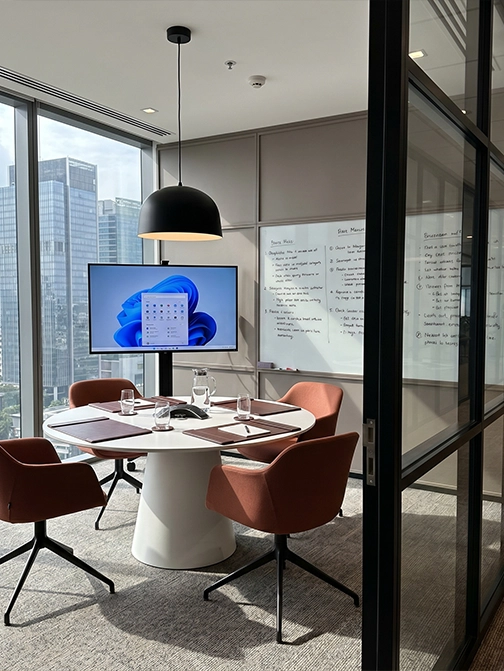
How the Codex resolves itThe Compliance/Regulatory Surface KPI maps which rooms must read regulator-grade versus which can run team-optimised. Define commits to a regulator-readable zone — meeting rooms, audit zones, board area — finished and laid out for external scrutiny, with operational floors right-sized for daily work.
Tension 02 Multi-stakeholder visitor flow vs. team focus.
With 7–10 visitor types per month — regulators on Tuesday, JV partners Wednesday, lenders Thursday, ESG auditors Friday — energy HQs carry more transit traffic than most sectors. Teams trying to focus through this volume suffer; visitors trying to be received cleanly meet awkward improvisation.
How the Codex resolves itThe Visitor Frequency KPI quantifies the volume. Define commits to a front-of-house perimeter — visitor reception, meeting rooms, hospitality zones — that absorbs the diversity without spilling into team floors. Teams protect their focus; visitors get the reception their role expects.
Tension 03 Authority depth vs. decision speed.
Energy companies have unusually deep authority stacks — boards, regulators, parent companies, JV partners, project committees, lender consortiums. Each layer needs spatial expression (board rooms, committee rooms, partner zones). But governance theatre over-built becomes operational drag — every routine decision routed through ceremonial spaces.
How the Codex resolves itThe Decision Authority Layers KPI maps which authorities meet how often. Define commits to a layered governance footprint — formal board space for quarterly use, flexible committee rooms for monthly use, team-scale meeting rooms for daily use. Hierarchy expressed at the right cadence.
Tension 04 Long project cycles vs. short team cycles.
Energy projects run 5–25 years. Energy teams cycle every 18–36 months. The workspace must serve both rhythms — durable enough to age gracefully across a 25-year solar park’s lifespan, flexible enough to accommodate a team that looks completely different in three years.
How the Codex resolves itDecode reads the project-portfolio trajectory alongside the team trajectory. Define commits to a durable shell with adaptive cores — building-finish quality calibrated for long horizon, room configurations and infrastructure designed for periodic reconfiguration. The workspace ages without becoming dated.
Tension 05 Stated tier vs. utility-business identity.
Many energy companies — particularly older utilities and state-linked operators — carry austere operational cultures. The brief sometimes says Luxury, signalling modernisation; the firm’s identity says Premium-functional, signalling continuity. The wrong choice alienates either visitors or the workforce. Both matter.
How the Codex resolves itThe Tier-Reality Match Score calibrates stated ambition against operational identity. The aim isn’t to suppress modernisation — many energy firms genuinely warrant Luxury for customer-facing zones. The aim is conscious choice: where Luxury serves, where Premium serves, where Semi-Premium honours the operational reality.
The KPIs that define energy
workspaces.
Compliance/Regulatory Surface
Visitor Frequency
Decision Authority Layers
A renewables operator. 18,000 sq.ft corporate HQ. Six-month visitor analysis at Decode.
Stylised study; not derived from a single client engagement.