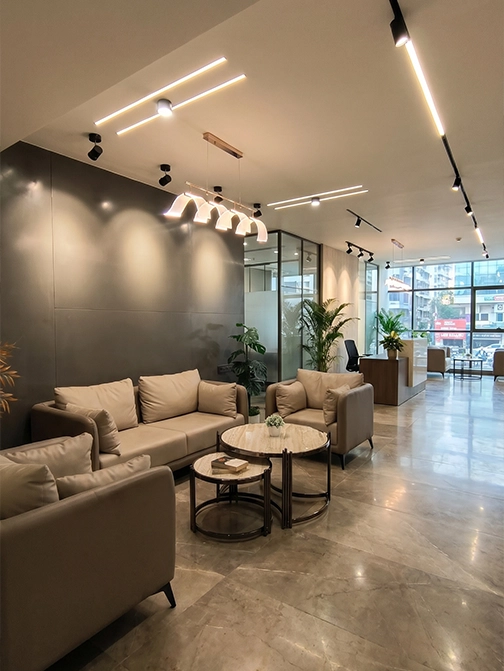
Where the workspace scales with the team — and helps win the offer.
What technology workspaces actually are.
The workspace is a recruitment lever.
Headcount Trajectory is unforgiving.
Hybrid work reshapes everything.
Workspace Type Diversity is the design problem.
Tension Density is real.
What a Codex engagement surfaces — and resolves.
Tension 01 Recruitment signal vs. operational density.
Leadership wants the workspace to read confident to candidates — natural light, café-grade pantry, breakout zones, collaboration energy. The operations team needs dense desking to fit current headcount plus the next funding-round-driven hire wave. The recruitment-signal floor and the operational-density floor pull in opposite directions on the same plate.
How the Codex resolves it
Decode surfaces both — the recruitment brief and the operational headcount math — in week one. Define commits to a candidate-path choreography through the visible 25–30% of floor, with operational density absorbed in the working zones. The candidate sees what they need to see; the team gets the desk count they need to have.
Tension 02 Today's hybrid ratio vs. tomorrow's hybrid ratio.
The firm’s hybrid policy says 2.5 days in-office. Three months ago it said 2. Six months ago it said “fully remote-friendly.” A year from now it may say 3 or 4. The workspace gets designed at a single point in this trajectory and lives across many. Designing for the lowest in-office expectation means empty floors when policy tightens. Designing for the highest means stranded infrastructure when policy loosens.
How the Codex resolves it
Decode reads the firm’s actual hybrid intent — not the policy doc, the lived rhythm. Define commits to a scenario-flexible layout: modular desking, scalable hot-desk infrastructure, locker provisions sized for the realistic range, infrastructure that supports 2–4 day attendance without major reconfiguration. The workspace flexes with the policy.
Tension 03 Open collaboration vs. focus protection.
Engineers need flow state — uninterrupted focus blocks, low ambient noise, controlled visual context. Product managers and designers need collaboration — whiteboards, standing huddles, in-room critique sessions. Sales teams need outbound calls and customer conversations. All three share the floor. The default open-plan tech workspace fails engineers; the default closed-cabin tech workspace fails collaboration.
How the Codex resolves it
The Tension Density KPI maps simultaneous work modes on a typical floor hour. Define commits to a zoned-by-mode floor plan: focus zones with acoustic protection for engineering, collaboration zones with whiteboards and acoustic permissiveness for product/design, phone-booth provision for calls — each sized to actual use frequency rather than aspirational claim.
Tension 04 Founder-era informality vs. enterprise-scale rigor.
The firm started informal — open seating, no cabin offices, everyone visible, the founder at a desk like everyone else. It worked at 50 people. At 250, leadership starts needing privacy for compensation conversations, customer-deal reviews, board prep, sensitive HR conversations. The brief inherits the founder-era informality but the business has outgrown it. Most tech firms hit this transition between 150 and 400 headcount.
How the Codex resolves it
Decode surfaces the maturity transition explicitly. Define commits to a graduated privacy model: focus rooms for sensitive 1:1s, glass-walled offices that signal availability while providing acoustic privacy, formal meeting rooms for board and customer engagements. The informal culture is preserved; the operational rigor is added. The workspace grows with the firm.
Tension 05 Stated tier vs. burn-aware identity.
Well-funded tech firms can credibly build Luxury workspaces. Capital-disciplined firms — bootstrapped, profitability-focused, or in restructuring — can’t justify it. Many firms in the middle are confused about which they are. The brief sometimes reflects the funding-round optimism; the CFO’s runway view reflects something more conservative. The workspace gets built to the brief.
How the Codex resolves it
The Tier-Reality Match Score calibrates stated tier against burn reality and runway discipline. The aim isn’t to push toward Semi-Premium reflexively — well-funded firms with talent-war pressure genuinely warrant Luxury for visible perimeters. The aim is honesty: Luxury where it serves recruitment and retention, Premium where it serves operations, Semi-Premium where capital discipline calls for it.
The KPIs that define technology workspaces.
Headcount Trajectory
Workspace Type Diversity
Tension Density