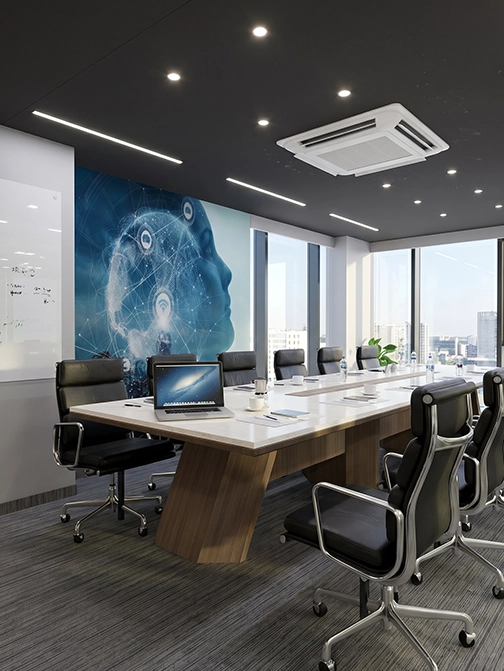
Where the workspace is the product.
What technology workspaces actually are.
The member is the end user. The operator is the buyer.
Workspace Type Diversity is the product, not just diversity.
FOH/BOH Allocation is revenue economics.
Visitor Frequency is constant, not occasional.
Operator economics shape every design decision.
What a Codex engagement surfaces — and resolves.
Tension 01 Member-experience signal vs. cost-per-seat economics.
Beautiful workspaces convert tours into members; cost-disciplined workspaces make operator margin. Both pressures are valid. The most experienced operators understand that overspending on finish doesn’t always pay back — but underspending on signature spaces costs the operator the tour-to-conversion rate that sustains the business. The trade-off is structural, not preferential.
How the Codex resolves it
Decode surfaces both — the operator’s per-seat economics and the member-experience benchmark — in week one. Define commits to a signature-zone allocation: Luxury-grade finish in the 15–20% of the floor that drives the tour-conversion moment (reception, primary lounge, signature meeting rooms), Premium throughout the member-occupied product, Semi-Premium in BOH. The math earns; the tour converts.
Tension 02 Hot-desk flexibility vs. dedicated-desk premium.
Hot desks generate higher revenue per sq.ft when fully booked, lower revenue when occupancy dips. Dedicated desks generate steady revenue but at lower per-sq.ft yield. Private offices generate the highest per-sq.ft but consume the most floor area. Each product type has a different demand profile, member retention curve, and revenue contribution. The mix determines the operator’s risk profile.
How the Codex resolves it
Decode reads the operator’s product mix strategy and demand projections by product. Define commits to a product-portfolio floor plan — sized to the projected mix, with reconfigurable zoning that lets the operator shift the balance as demand evolves. The floor serves the business model, not the brief’s snapshot.
Tension 03 Open-plan member energy vs. private-office quietude.
Members buying hot desks and open seating want energy — cafés, lounges, ambient activity, visible community. Members buying private cabins want quietude — acoustic isolation, controlled traffic, the privacy their price tier promises. The same floor must deliver both. Sharing reception, café, and meeting rooms creates spillover; isolating products creates dead zones.
How the Codex resolves it
The Workspace Type Diversity KPI maps product-type adjacencies and acoustic requirements. Define commits to zoned tier architecture: cabin tier positioned at the floor’s quieter edge, open product clustered around the active core, café and signature spaces serving both via choreographed common-area access. Member energy where it sells; quietude where it’s paid for.
Tension 04 Operator footprint vs. revenue footprint.
Reception, IT and AV infrastructure, member-services back-room, facilities and housekeeping, security, storage — necessary but cost-bearing. Operators chronically under-spec BOH at the design stage and then suffer for it operationally for years. Over-spec it and the floor leaks revenue. The right number isn’t intuitive — it depends on the operator’s product mix, scale, and service model.
How the Codex resolves it
The FOH/BOH Allocation KPI quantifies the target ratio. Define commits to a service-model-calibrated BOH — sized to the operator’s projected service load (concierge, IT, F&B, events), positioned for operational efficiency, finished to support staff longevity. The ratio is intentional, not residual.
Tension 05 Stated tier vs. operator-margin reality.
The brief sometimes says Luxury — driven by site location, competitive context, or founder ambition. The cost-per-seat math, given the projected pricing and occupancy curve, sometimes can’t support it. A Luxury fit-out at Mid-tier per-seat pricing has a 7–10 year payback that may not fit the operator’s capital plan. A Semi-Premium fit-out at Premium pricing won’t retain. The wrong calibration costs the operator either margin or members.
How the Codex resolves it
The Tier-Reality Match Score calibrates stated tier against operator-margin reality. The aim isn’t to push toward Semi-Premium reflexively — premium operators with strong pricing power genuinely warrant Luxury. The aim is honest: Luxury where the per-seat math supports it, Premium where the volume product earns, Semi-Premium where the operator is competing on price. Build to the unit economics that will be lived, not the brief’s aspiration.
The KPIs that define managed workspaces.
Visitor Frequency
Workspace Type Diversity
FOH/BOH Allocation