
Omnitech Engineering
What Omnitech asked for.
Omnitech Engineering is a precision-machined components manufacturer based in Rajkot, supplying customised engineered parts and assemblies to over 220 customers across 22 countries — Energy, Motion Control & Automation, Industrial Equipment Systems, and adjacent sectors. The company has grown multiple-fold over the past three years and is moving toward a public listing.
The ask was scaled to the moment. A corporate HQ adjacent to the manufacturing plant, large enough to host visiting Fortune-500 clients at a level matching the manufacturing standards they were coming to see — and structured to support the rapid, dynamic growth the company was already in the middle of.
The constraint that shaped everything: full vastu compliance, with no exceptions. Every space plan iteration was validated by the vastu team before feasibility — not retrofitted afterwards. The discipline ran from layout to material palette to entry sequence.
This is also a long-running engagement. APXWorks has been designing for Omnitech since 2018 — multiple projects across the company’s growth, with this 50,000+ sq.ft headquarters the most recent chapter.
What eight years of working with Omnitech told us.
The hierarchy was going to keep changing. The company’s growth meant the seating chart Omnitech showed us on day one wouldn’t match the seating chart twelve months later. Team sizes, reporting lines, the number of senior cabins required — all moving. The building had to be flexible enough to absorb organisational change without re-doing the office, not just larger than the current headcount required.
Every square foot of carpet had to do work. 50,000+ sq.ft sounds generous until you list what it has to hold: a Fortune-500-grade lobby, multiple boardrooms, a training auditorium, departmental floors, executive cabins, a library, a canteen, a vastu-compliant pooja room, and the circulation between all of them. The Decode reading was unambiguous — this is a building where unused area is wasted area. Every zone earns its placement.
Vastu was not a constraint to manage around — it was the framework to design within. Every space plan iteration was validated by the vastu team before structural feasibility was even checked. Entry sequence, room orientation, the position of the pooja room, the placement of the boardroom — all set inside vastu principles from day one. The finished office reads as a coherent composition, not as a building that had vastu applied after the fact.
Five decisions that shaped the project.
A double-height arrival sequence calibrated for Fortune-500 visitors.
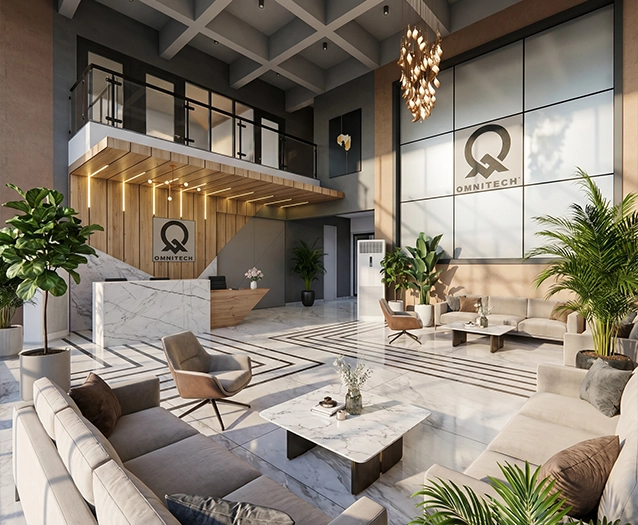
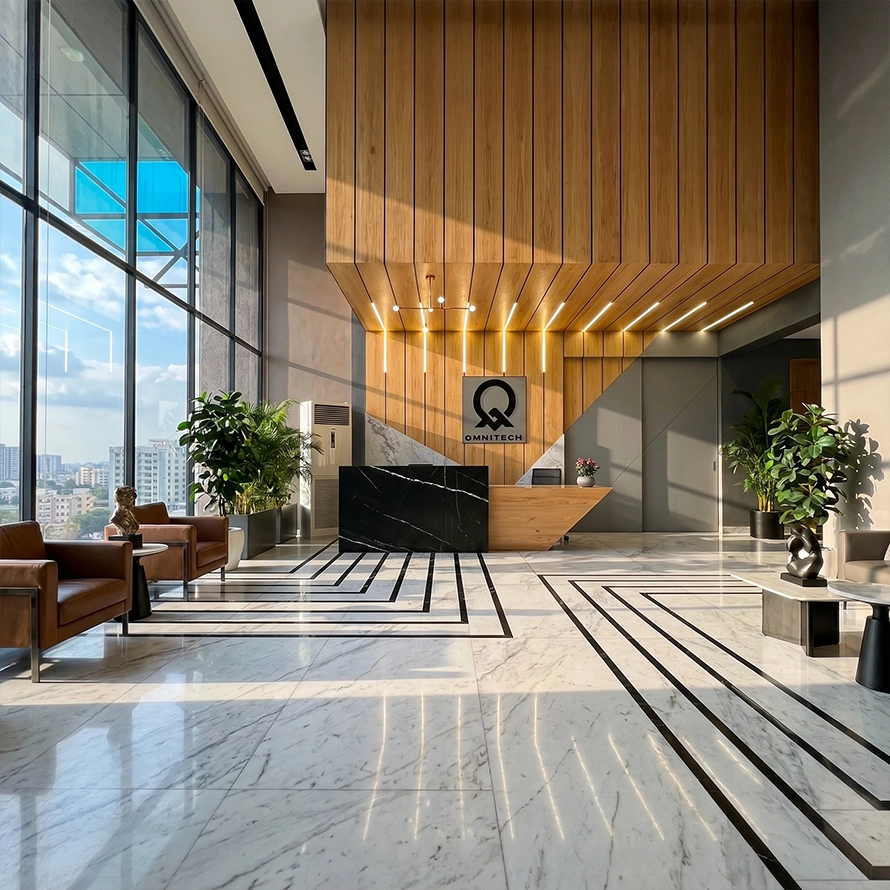
The main lobby reads at the scale Omnitech’s visitors expect. A double-height marble-clad volume with a timber-clad mezzanine, the Q-mark logo wall lit from behind, a sculptural sand pendant overhead, and a chevron-patterned marble floor. The reception desk is a single piece of book-matched marble; the hospitality seating is generous enough that an entire visiting delegation can wait without anyone standing.
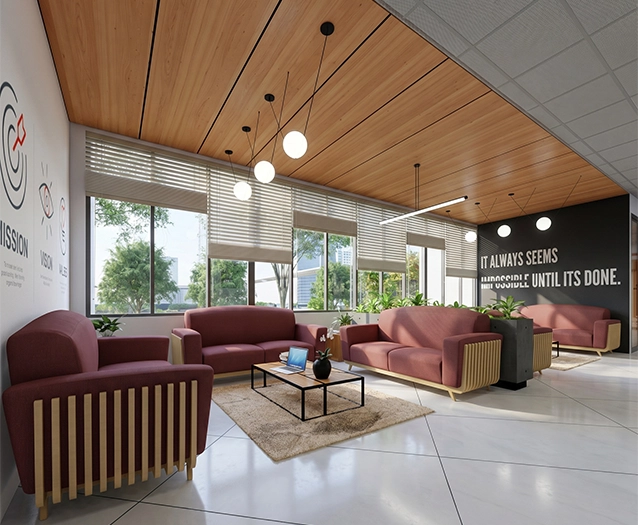
Beyond reception, a second arrival moment sets the tone: a Mission/Vision/Values lounge with warm burgundy sofas under a wood-clad ceiling and a “It always seems impossible until it’s done” wall — moving visitors from impressed to oriented before the conversation starts.
Vastu as architecture — including a dedicated pooja room.
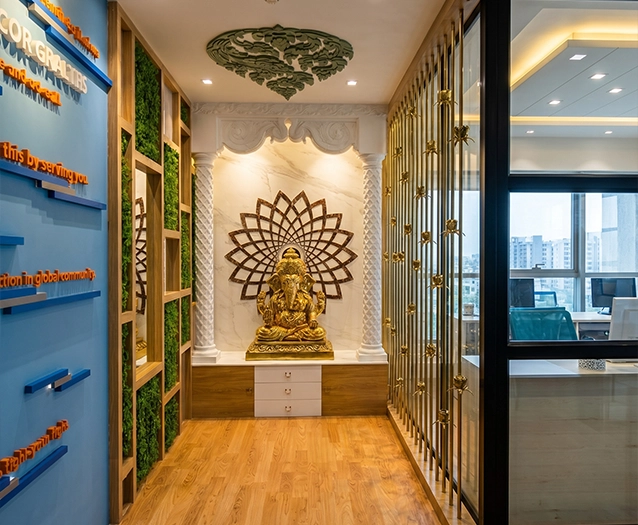
The pooja room is built into the building’s plan as a room of its own, not an alcove. A marble-pillared niche with a gilded Ganesh, framed by a brass-rod screen and a moss-clad wall, sitting on a hardwood floor at the threshold between zones. The plan position, the orientation, the entry approach — all set by the vastu team.
This is the visible signal of an invisible discipline. Every other room’s orientation, doorway and material palette was validated to the same standard. The boardroom faces the direction it does because vastu required it. The CXO cabins are where they are because vastu required them there. Nothing about the office layout looks accommodated or compromised — because the layout was designed inside the rule, not against it.
Flexible engineering floors that absorb organisational change.
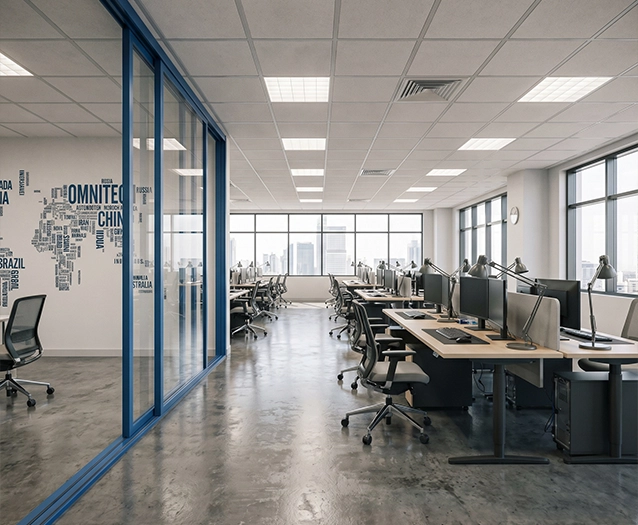
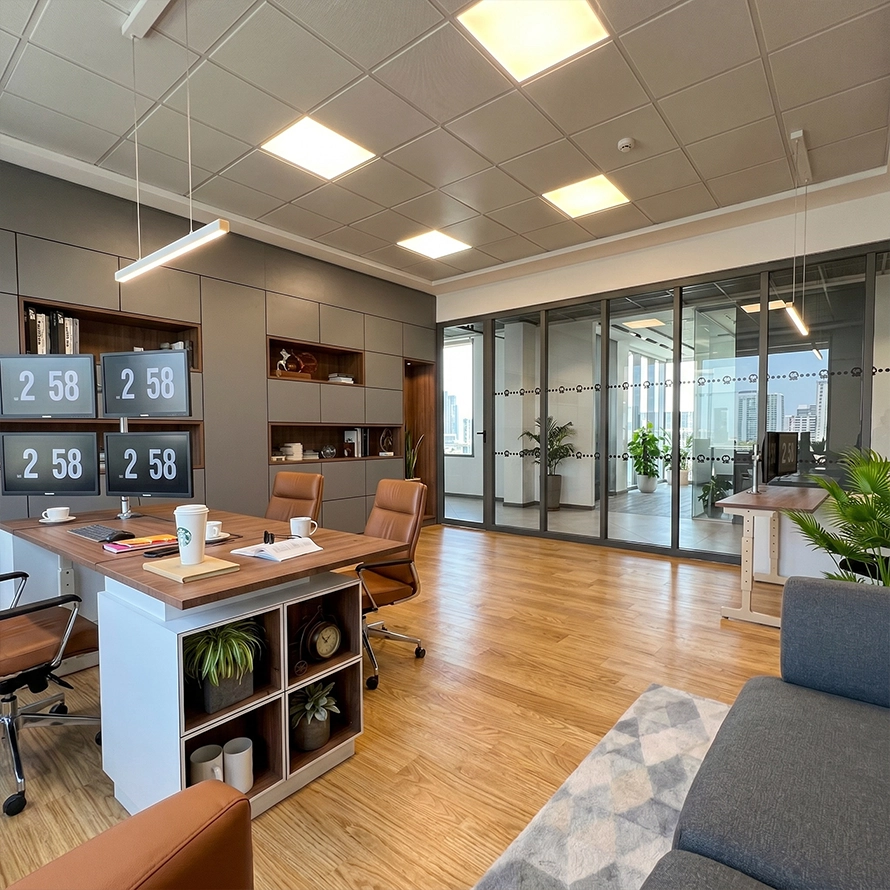
The engineering bays are designed for re-organisation. Modular desk clusters with mid-height acoustic dividers, demountable glass partitions where rooms might need to become other rooms, polished concrete floors that don’t reveal where furniture used to sit. When team sizes shift — and they do — the office shifts with them in days, not months.
Above one zone, the company’s supply destinations are spelled out as a typographic globe — country names in deep blue, sized by trade volume, forming a continental outline that doubles as a daily reminder of who is on the other end of the work. The graphic stays put; the desks beneath it can move.
Boardrooms with sound isolation built into the envelope.
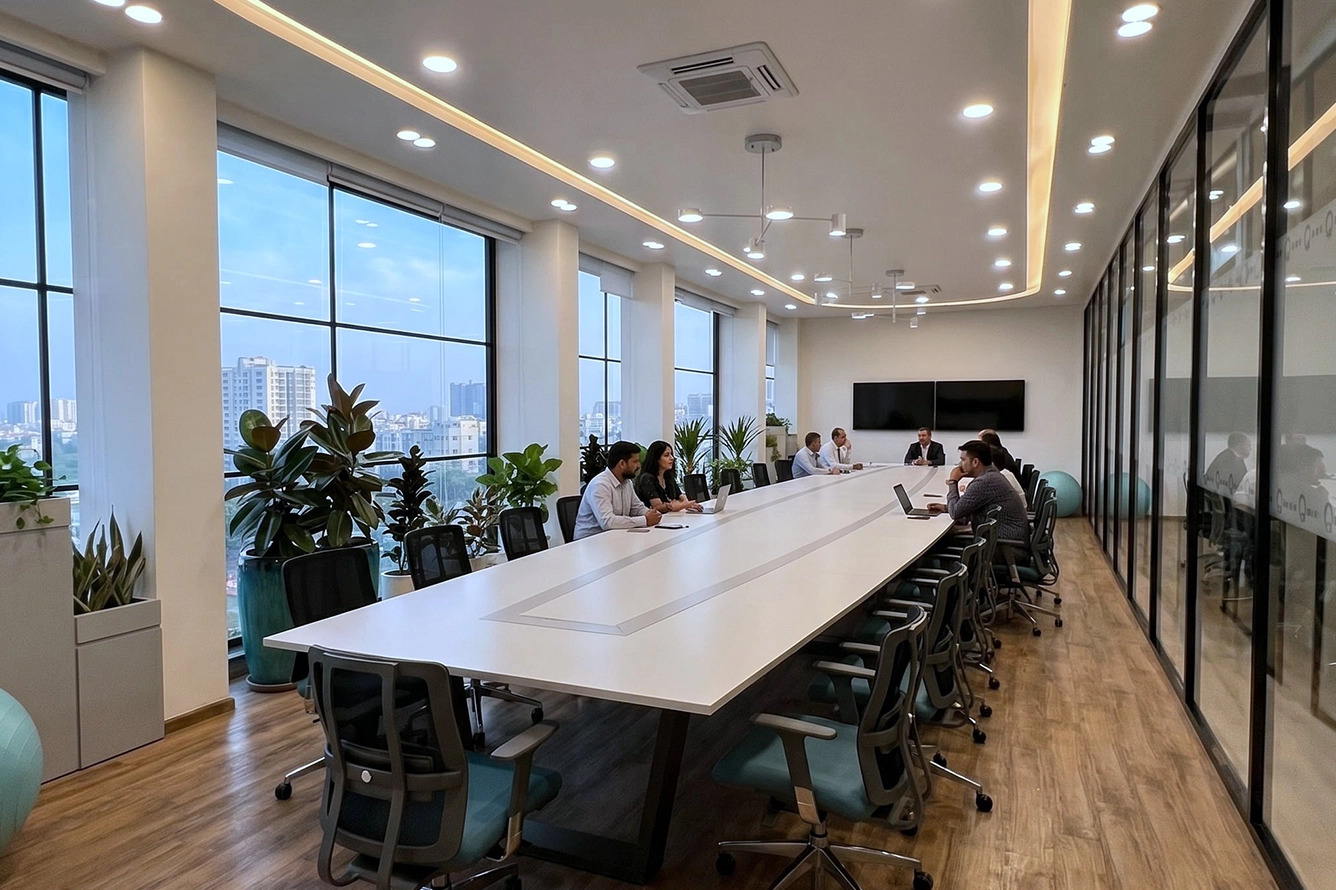
The main boardroom seats fourteen at a single white quartz table. Acoustic-rated glazed walls on the corridor side, drape-able blinds on the city side, a curved cove of indirect lighting, and a planted edge along the window wall. Twin TVs at one end for client video calls; chairs in mesh and pale blue.
What’s harder to see in the photograph is the wall buildup — double-glazed acoustic partitions, sealed jamb details, dedicated air-handling so HVAC noise doesn’t drift in. Decisions about supplier contracts, pricing strategy, and the IPO have been made in this room. The room is designed so what’s said in it stays in it.
An in-house training auditorium — because the company hires at scale.
Few manufacturing HQs at this scale dedicate floorplate to a proper training auditorium. Omnitech does. Tiered seating with tablet-arm chairs in red, blue and grey, a ceiling-mounted projector, a hardwood lectern with microphone, daylit glazed walls with adjustable blinds.
The room is the architectural answer to the brief’s quietest line — “expanding teams”. A precision-engineering exporter scaling rapidly cannot rely on hiring trained people; the people get trained inside the company. The auditorium is where new joiners are inducted, where supplier teams are briefed, where the IPO roadshow rehearsals happened. The space says: we plan to keep growing.
Walking through.
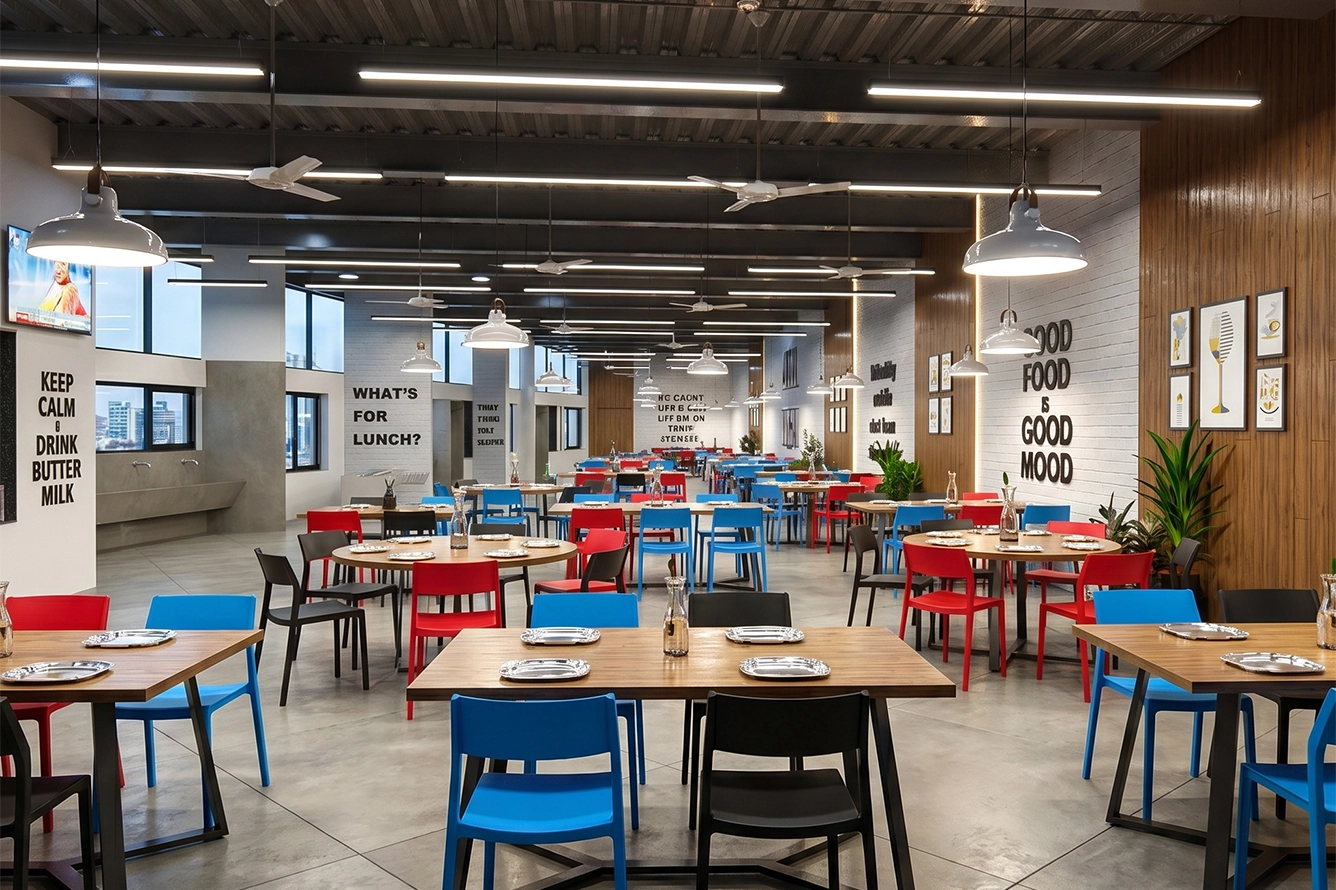
Project Gallery · Across the 50,000 sq.ft
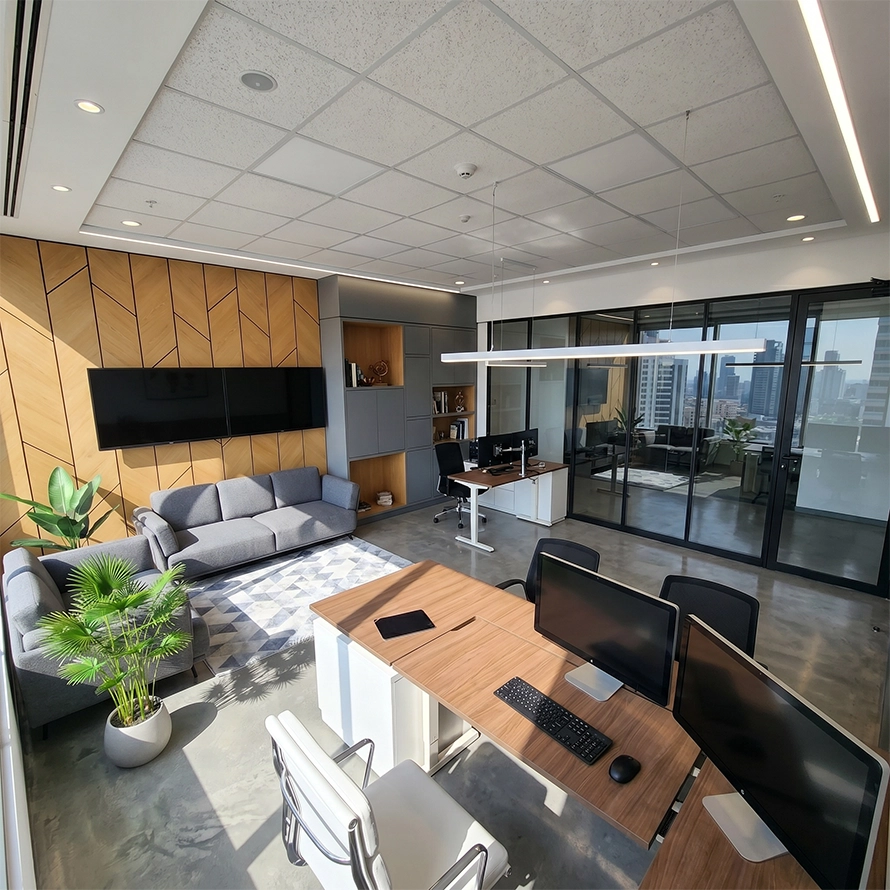
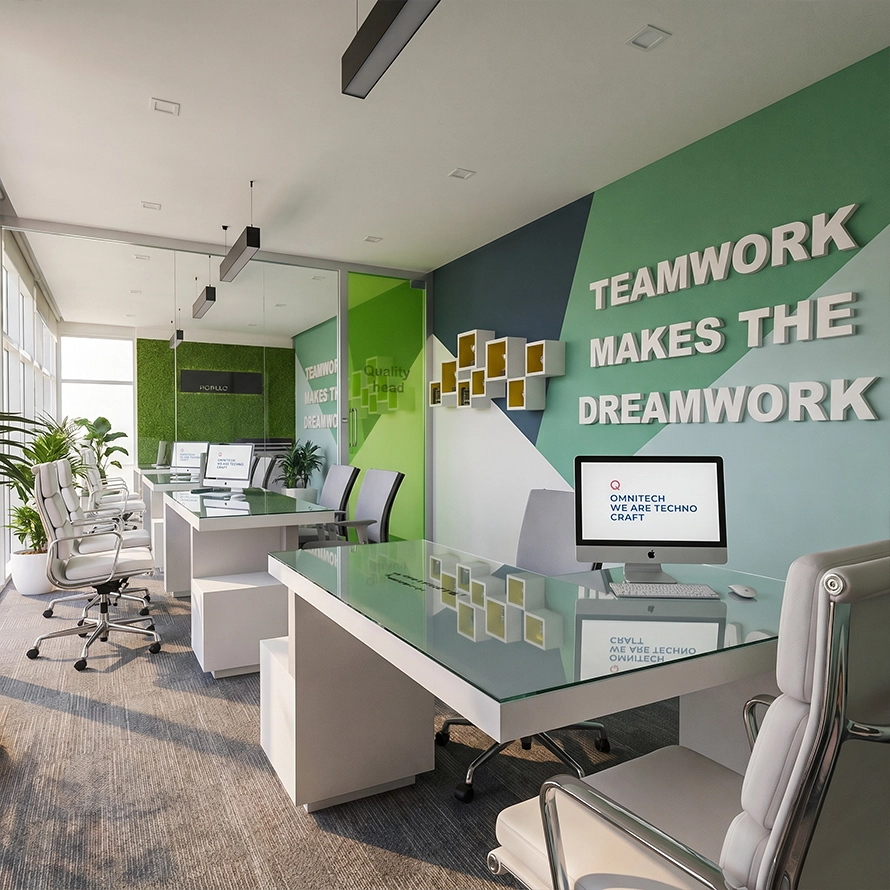
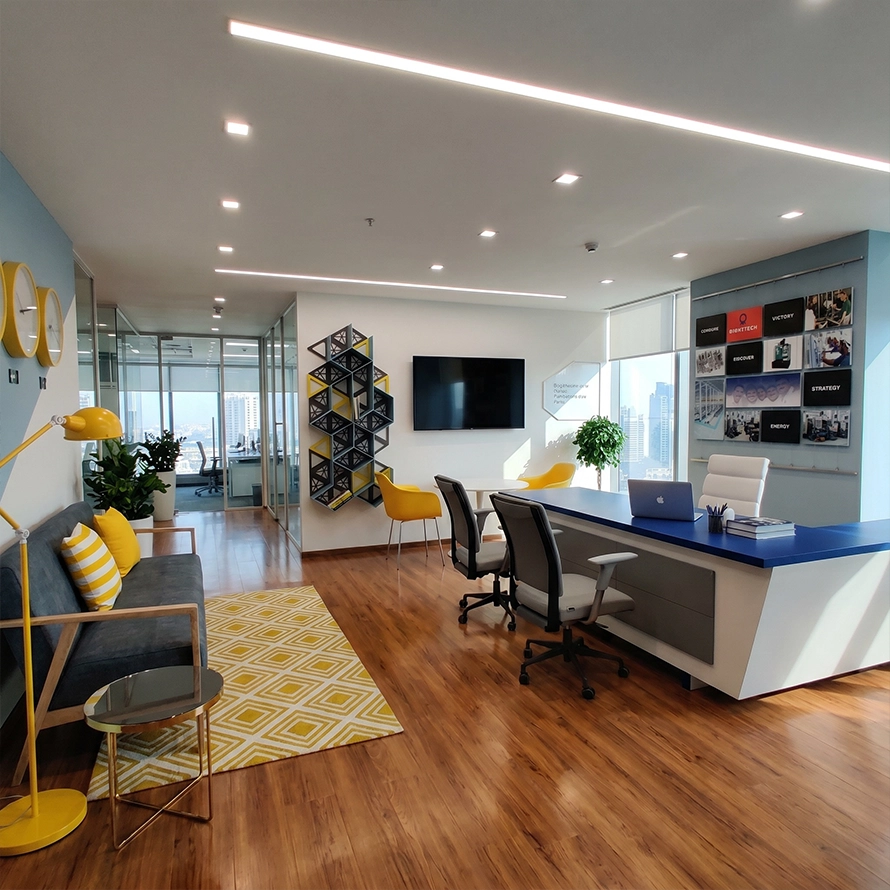
What landed, in operation.
The office has been in operation since 2025 and the response was the one Omnitech wanted: international clients arriving for plant visits found a corporate environment that matched the manufacturing standards they had come to inspect. Several visiting delegations described the building as the most surprising part of the trip — in a sector where it’s the equipment that’s usually the surprise.
Cross-team communication has tightened. The flexibility built into the floors has been used — departments have grown, moved and reorganised inside the same envelope without re-doing the office. The training auditorium has done the job it was designed for, including hosting rehearsals for investor presentations.
From an APXWorks methodology perspective: the brief asked for “a building that supports growth” — the Decode reading reframed it as “a building that grows with the company.” Both were delivered. Eight years into the relationship, the partnership is the credential.